

On Remembering Atatürk and Our Ways of Remembering
In a speech marking the November 10 commemoration, Atatürk Institute Acting Director Dr. Faruk Yaslıçimen examined how the image of Atatürk has taken shape in collective memory. The speech underlined the importance of understanding Atatürk within his historical context, as a human being and the founder of a state.
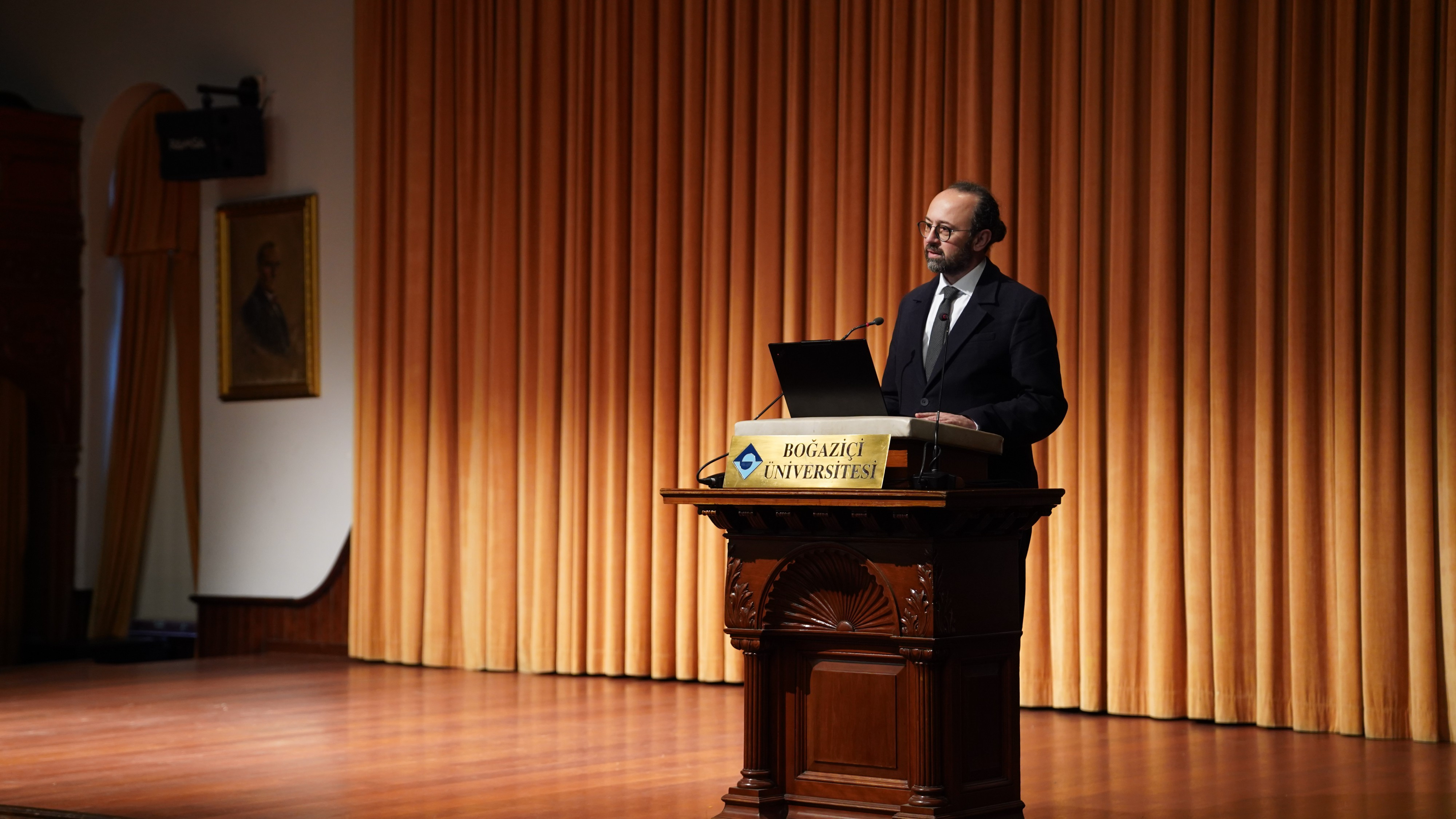
Boğaziçi University Atatürk Institute Acting Director Dr. Faruk Yaslıçimen gave a speech titled “On Remembering Atatürk and Our Ways of Remembering” to mark the 88th anniversary of the death of Mustafa Kemal Atatürk, founder of the Republic of Türkiye. The speech opened with a question: “Are we all remembering the same Mustafa Kemal Atatürk?” It went on to examine the image of Atatürk that lives in the nation’s collective memory, an image renewed every year through national commemoration. The speech also noted that the portrait of Atatürk drawn over the decades has often been accepted without question.
The speech drew on Atatürk: An Intellectual Biography by Prof. Şükrü Hanioğlu, a member of the institute’s advisory board and a faculty member at Princeton University. The Institute Director recalled that approaches casting Atatürk as a “superhuman being” began to take shape during his lifetime. He described how this narrative was built in the early writings of authors from Atatürk’s close circle.
Drawing again on Hanioğlu’s book, the speech also turned to sayings attributed to Atatürk that are not actually his. Among them are “The future is in the skies”, “The Turkish driver is a person of the noblest sentiments” and “When the homeland is at stake, all else is detail”. Over time, such approaches that describe him as übermensch settled into collective memory and reinforced the idea of an “infallible leader.” As a result, conflicting portraits of Atatürk emerged in different periods. These portraits presented him at times as an anti-communist, at times as a socialist, at times as anti-religious, and at times as a leader explained through religious references.
Dr. Yaslıçimen emphasized that Atatürk’s decisive role in shaping modern Türkiye is beyond dispute. He added, however, that like all other leaders, Atatürk was a product of the environment in which he grew up and of the historical conditions of his time. He said that remembering the past within its own historical context is a responsibility of both the state and society. Neither praise of the Ottoman past nor its condemnation, he noted, can light the way forward. The speech closed with the message he hoped this year’s commemoration would leave:
“Neither diminishing Mustafa Kemal Atatürk’s significance nor placing him above history as a superhuman being can clear the way ahead of us… As long as our collective memory allows us to look at the past with moderation, fairness and a sense of proportion, we can walk into the future with a realistic self-confidence, our feet firmly on the ground.”